


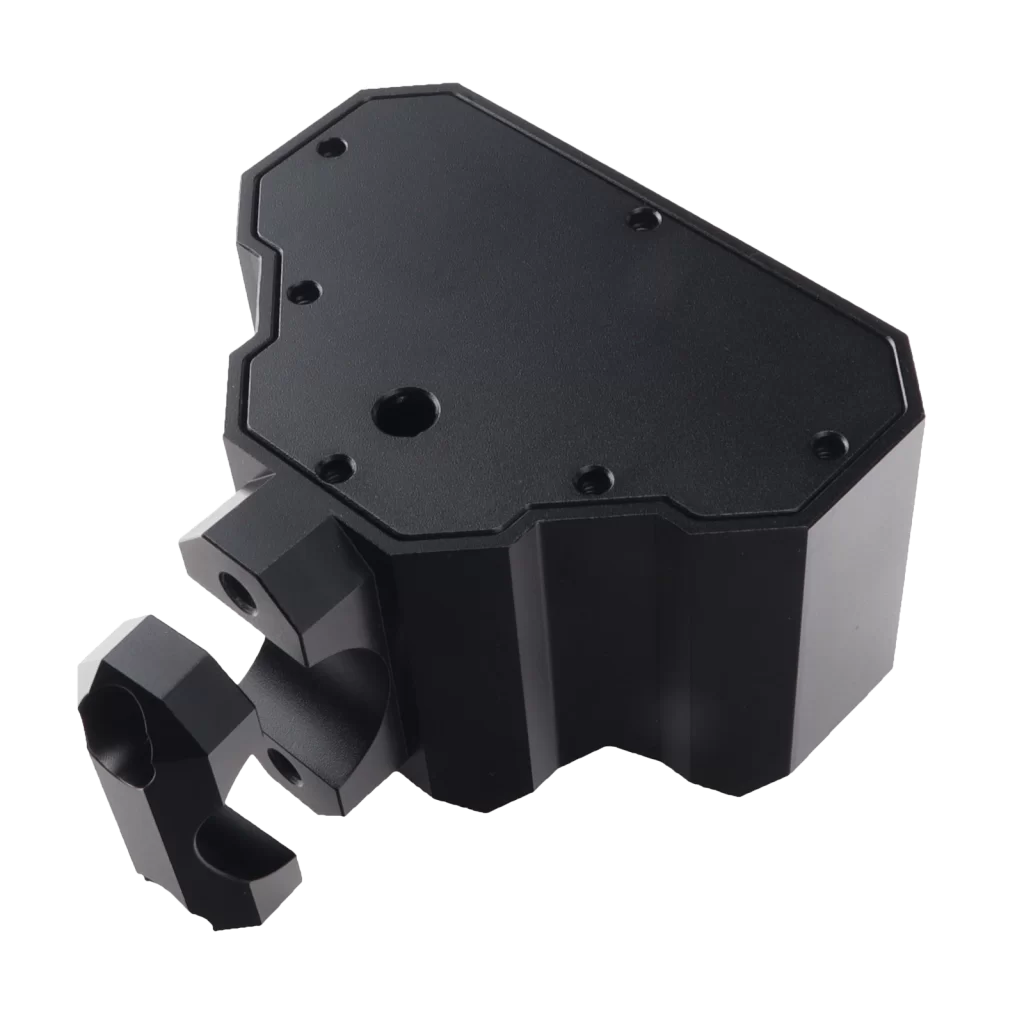
High quality anodized brass stainless steel aluminum OEM milling turning automobile motorcycle parts custom CNC machined parts
How CNC Milling works?
CNC milling machine processing in fact the application of the “differential” principle, its working principle and process is described as follows.
1) According to the tool path required by the processing program, the NUMERICAL control device differentiates the path according to the corresponding coordinate axis of the machine tool with the minimum movement (pulse equivalent) as the unit, and calculates the number of pulses that need to move in each coordinate.
2) Through the “interpolation” software or “interpolation” arithmetic unit of the NUMERICAL control device, the required trajectory is fitted with the equivalent broken line as the unit of “minimum movement”, and the fitted broken line closest to the theoretical trajectory is found.
3) According to the trajectory of the fitted broken line, the NUMERICAL control device continuously allocates the corresponding coordinate axis to the feed pulse, and makes the coordinate axis of the machine tool move according to the assigned pulse through the servo drive.
Advantages
3. The device is not easy and is not suitable for milling thin workpieces.
Materials for CNC Milling
| Aluminum | Steel | Copper / Brass / Titanium / Zinc | Plastics | Others |
|---|---|---|---|---|
| 2A12 | 201 | Copper | ABS | Bakelite |
| 5052 | 303 | Brass | Transparent ABS | Rubber |
| 7075 | 304 | Titanium(Ti) | Polycarbonate (PC) | FR4 |
| 6061 | 316 | Zinc(Zn) | Acrylic (PMMA) | Others |
| others | 430 | Mild steel(Low Carbon Steel) | Delrin/Acetal (POM) | |
| Alloy steel | Polyethylene (PE) | |||
| Tool steel | PTFE (Teflon) | |||
| PEEK |